

Data Modernization Imperative
For CIOs leading large organizations, the real question is not if you should modernize, but how to do it without disrupting operations, overspending, or facing long delays.
Legacy data tools, custom ETL systems, and years of data debt are both a risk and a chance for growth. Companies that take advantage of this first will shape the competition in the coming years.
At Anblicks, we have guided some of the most data-intensive enterprises through this transition. What we have learned and what keeps many modernization programs from realizing their potential is that the binary choice between migration and modernization is a false one. With the right framework and the right tooling, you can have both speed and depth.
“The organizations that treat data modernization as a technical project rather than a strategic transformation will find themselves migrating twice – once to the cloud, and once again to fix what they missed.”
What Keeps CIOs Up at Night
Every CIO we speak with is navigating a similar set of tensions. The pressures are real:
Unsustainable Costs
Maintaining legacy systems while simultaneously funding cloud adoption drains IT budgets faster than boards anticipate.
Knowledge Erosion
Tribal knowledge embedded in decades-old legacy scripts and custom orchestration logic with little or no documentation – creates enormous risk when key staff leave.
Velocity Demands
The business wants AI-powered analytics and real-time pipelines yesterday. Legacy infrastructure cannot deliver at that pace.
These pressures do not go away on their own, and traditional methods often make them worse. This is the modernization paradox, and it is what Anblicks is here to address.
Migration vs. Modernization: A False Choice
For years, CIOs have been offered two options: Lift & Shift, which means moving quickly and improving later, or Fix & Shift, which means rebuilding everything but facing high costs and delays. Both options have benefits, but also big drawbacks.
| Migration (Lift & Shift) | Modernization (Fix & Shift) | |
|---|---|---|
| Approach | Like-for-like transfer with minimal changes to architecture. | Strategic transformation of data infrastructure, governance, and architecture. |
| Time to Value | Faster initially but accrues technical debt. | Longer upfront, but durable outcomes. |
| Risk | Low short-term, higher long-term due to missed optimization. | Higher upfront without the right partner and tooling. |
| Cost Reality | Surprisingly high - cloud native features go unused, driving hidden costs. | Higher redesign cost, but offsets via operational savings. |
| AI Readiness | Limited - legacy structures constrain ML/AI use cases. | Full - clean, governed, cloud-native data ready for AI. |
The hard truth about just migrating is that ‘optimize later’ almost never happens. Teams move on, priorities change, and the technical debt just becomes more expensive in the cloud, with added infrastructure costs. On the other hand, trying to fully modernize without the right tools can take so long that the business loses patience.
What Anblicks has proven in production is that you do not have to choose. Spec-driven development powered by Snowflake Cortex Code collapses this trade-off entirely.
Introducing Snowflake Cortex Code: The Modernization Multiplier
Snowflake Cortex Code (CoCo) is an AI-powered coding agent native to the Snowflake Data Cloud. It provides intelligent, context-aware assistance for data engineering, SQL development, and analytics. Critically for enterprise modernization, it supports multi-agent coordination: it can spin up specialized sub-agents for research, code generation, testing, and validation, all working in concert.
But the real breakthrough is not a single feature. The real value comes from using Cortex Code together with a structured, spec-driven approach, which Anblicks has tested in complex migrations.
“Snowflake Cortex Code is not just a productivity tool – it is a force multiplier that lets a team of four do what previously required seven people, in half the time.”
The Anblicks Approach: Spec-Driven Development
Anblicks has developed a proven three-step methodology that uses Snowflake Cortex Code to drive structured, repeatable modernization at scale. This framework transforms the most complex legacy environments into clean, cloud-native Snowflake architectures with full AI readiness.
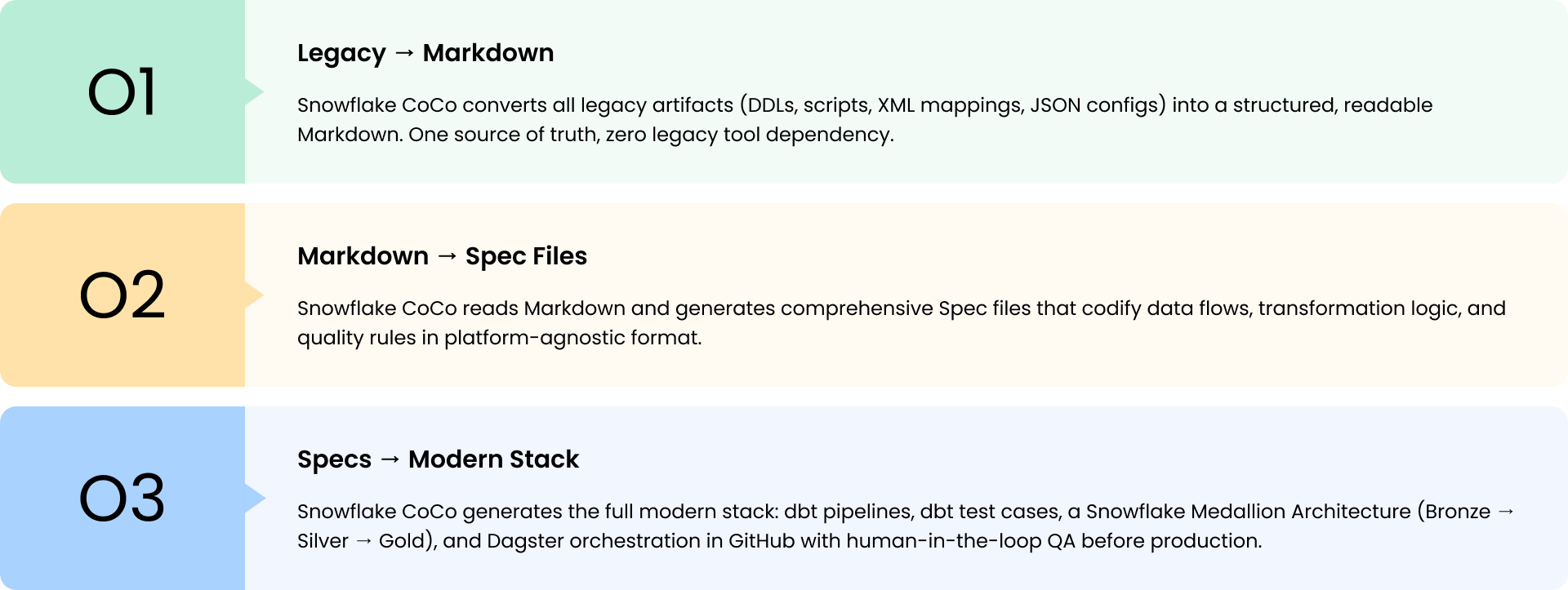
Inherently repeatable: once the framework is established, each successive migration runs faster, with greater confidence and lower cost. It is not a project – it is a factory.
Real-World Impact: A Multi-Billion Dollar MarTech Enterprise
To illustrate what this methodology delivers in practice, consider a recent Anblicks engagement with a US-based multi-billion-dollar MarTech firm. The CIO needed to modernize legacy Oracle environment that had been accumulating complexity for over 20 years.
The Challenge
- Knowledge is locked in legacy validation engines, XML-based mapping and transformation engines, custom orchestration with dynamic SQL, and Perl-generated table structures – with no meaningful documentation.
- A complex Oracle backend with 300+ tables per client across multiple data marts spanning 20+ client instances.
- An estimated cost of approximately $350,000 per client migration using a conventional approach (seven months x seven resources), making the program economically unsustainable on a scale with multiple clients.
The Anblicks Solution
Anblicks deployed its spec-driven development framework powered by Snowflake Cortex Code, enabling a team of four specialists to deliver each migration in 3.5 months – with full QA and production deployment included.
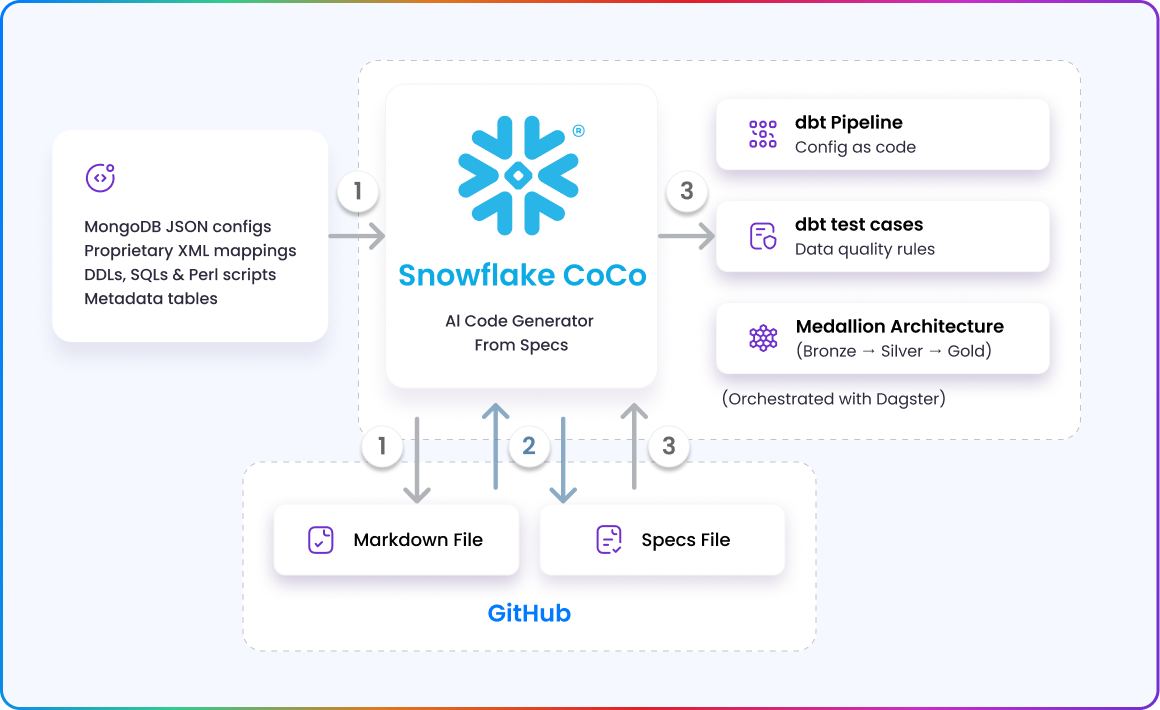
The Results
Cost Reduction
$350K → $100K per migration
Faster Delivery
7 months → 3.5 months
Total Savings
Across 20 migrations
Table Footprint Reduced
Faster query performance
Fewer Tables Total
~180 reduction × 20 clients
Clients Migrated
Repeatable factory framework
Why CIOs Choose Anblicks as Their Modernization Partner
Anblicks brings a rare combination of deep technical execution capability and strategic modernization perspective. Our practice is built on three principles that distinguish us in the market:
Production-Grade Rigor
Every engagement ends with tested, monitored production pipelines, not POCs. Human-in-the-loop QA at every sprint
Repeatable Framework
A migration factory - not a one-off project. Each client runs faster and cheaper than the last.
AI-Ready by Design
Data restructured - not just moved. Every migration supports Snowflake Cortex AI and enterprise data agents from day one.
Recommendations for CIOs: Where to Start
Data modernization at scale does not begin with platform decision – it begins with clarity about what you are modernizing, and why. Here is how we recommend CIOs frame the journey:
Audit your legacy estate ruthlessly.
30-40% of objects are typically redundant. Spec-driven ingestion surfaces this in days, not months.
Define AI readiness as a first-class outcome.
Skip the clean schema and governed lineage now, and you will modernize again in three to five years
Demand repeatability from your partner.
One-off migrations don’t scale. Insist on a framework that accelerates with every successive migration.
Measure footprint reduction - not just migration completion.
Track table reduction, pipeline simplification, and governance coverage as core program KPIs.
Conclusion: The Window for Differentiation Is Now
The convergence of AI-native platforms like Snowflake Cortex Code, proven modernization methodologies like Anblicks’ spec-driven framework, and genuine enterprise AI demand has created a moment CIOs cannot afford to miss. The organizations that modernize thoughtfully – not just quickly – will build data platforms capable of sustaining competitive advantage for the next decade.
“The question is not whether your legacy data estate is holding you back. The question is whether your modernization strategy is ambitious enough to set you free.”
To learn how Anblicks can accelerate your modernization journey with Snowflake Cortex Code, contact us for a no-cost assessment of your current data estate.