

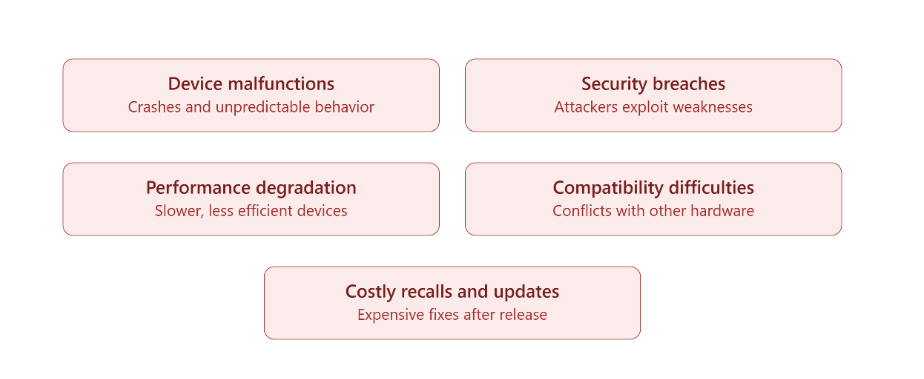
Firmware, which resides directly on the hardware, dictates how a device operates. Bugs as well as vulnerabilities in firmware can lead to:
- Device Malfunctions: The device might act unpredictably, crash, or stop working.
- Security Breaches: Hackers could exploit weaknesses to access data or take control.
- Performance Degradation: Devices may slow down, freeze, or use resources poorly.
- Compatibility Difficulties: The firmware might not work well with other hardware or software.
- Costly Recalls and Updates: Finding problems after release can lead to expensive fixes and hurt your reputation.
Key Firmware Testing Methodologies
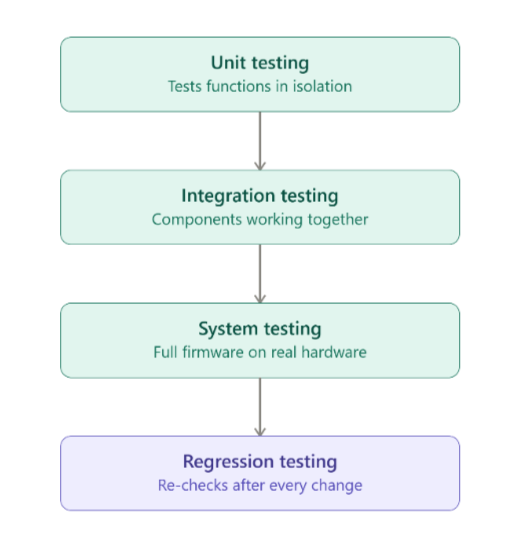
There’s no single way to test firmware, each methodology catches different problems at a different stage of development. Used together, they confirm that individual functions work correctly, that components cooperate as expected, and that the finished firmware performs reliably once it’s running on real hardware. Below are the four core approaches teams rely on most.
Unit Testing:
Unit testing checks each part or function of the firmware separately. This procedure helps find bugs early in development. Tools such as CppUTest or Unity are often used for this purpose.
Integration Testing:
Integration testing makes sure different parts of the firmware, or the firmware and hardware, work well together. This helps confirm that everything works as expected when combined.
System Testing:
System testing checks the whole firmware running on the actual hardware, often in conditions similar to real use. This includes tests for how well it works, how fast it runs, and how it handles stress.
Regression Testing:
Regression testing happens after changes or bug fixes to make sure nothing new has broken and everything still works as before.
Automation in Firmware Testing
Automating firmware tests saves time and helps keep up with frequent changes during development. Automated tests manage repetitive tasks quickly and reliably, so engineers can spend more time on complex problems. This usually includes:
- Test Frameworks: Utilizing specialized frameworks for embedded systems.
- Hardware-in-the-Loop (HIL) Testing: Simulating the environment and external signals that the firmware will encounter.
- Continuous Integration/Continuous Deployment (CI/CD): Integrating automated tests into the development pipeline to catch defects early and often.
Challenges and Best Practices
Firmware testing delivers unique challenges owing to to the direct hardware interaction as well as resource limitations. Best practices include:
- Early Test Planning: Start thinking about testing during the design phase.
- Clear Test Cases: Write test cases with clear goals and expected results.
- Version Control: Carefully track changes to both firmware and test code.
- Documentation: Keep thorough records of test steps and results.
- Experienced Team: Make sure your team knows both software and hardware well.
When teams use strong firmware testing strategies, they can improve product quality, security, as well as lifespan. This also helps build confidence with users.
Conclusion
Thorough firmware testing is beyond a quality check. It is essential for supplying reliable and secure technology. By realizing how important firmware is and using good testing methods, companies can lower risks, cut costs, and make sure their products satisfy today’s high standards.