

A few months after an enterprise AI chatbot went live, the finance department called an emergency meeting.
Nothing was broken.
Users loved the platform. Adoption numbers looked fantastic. Leadership was celebrating. The AI assistant was answering customer questions, summarizing documents, generating reports, and generally causing everyone to feel like they’d finally caught the AI wave before their competitors.
Then the cloud billing showed up, and all of a sudden there was no celebration.
During the pilot, monthly AI expenditures were only a few hundred dollars. In production, they rose to tens of thousands. More departments requested access. Each new workflow produced more prompts. Because larger models performed better, engineers experimented with them.
The problem wasn’t the AI. The problem was that nobody had planned for AI economics at scale.
And this story is becoming painfully common.
Enterprise AI Costs Are Bigger Than Just the Model – But the Model Is Where Costs Spiral Fastest
Enterprise AI spending doesn’t come from one line item. It’s spread across infrastructure and compute, data pipelines and tooling, model training and fine-tuning, governance and compliance, and the people who build and babysit all of it.
Large Language Model (LLM) inference – the cost of actually running prompts through a model and getting responses back – is only one slice of that picture. But it’s the slice that tends to grow the fastest, the least predictably, and with the least visibility, because it scales with usage in a way traditional infrastructure costs don’t.
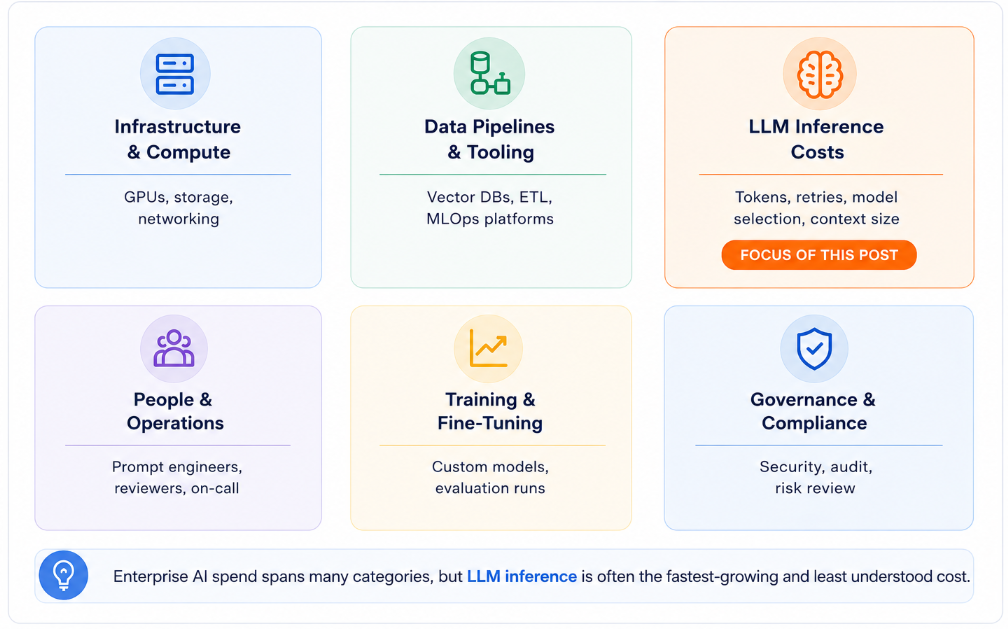
Figure 1: Enterprise AI spending spans several categories — LLM inference is often the fastest-growing and least understood.
That’s what this article is about: why LLM inference costs climb faster than teams expect, what actually drives that growth, and the concrete techniques that bring it back under control – without sacrificing the quality of what you’ve built.
Why LLM Costs Increase Faster Than Expected
The Pilot Trap Nobody Talks About
Most AI projects start small: a few users, little traffic, perhaps a proof-of-concept running on a high-end model. Costs appear innocuous at this stage – sometimes so small that executive dashboards don’t even show them.
Then production happens, and strange things start to occur.
A customer care bot that handled 500 test chats now handles 50,000 chats per week. Ten departments get added to the internal document search. Teams begin feeding entire PDFs into prompts because it’s simpler than building a proper retrieval mechanism.
Token volume increases vertically.
Silently, what looked like a $500 monthly trial turns into a $25,000 operational expense.
This is where it gets awkward: most businesses don’t notice until the invoice arrives.
Traditional Software Scales Differently Than LLMs
Traditional software has relatively predictable scaling dynamics. More users generally mean more servers, more storage, maybe a bigger database cluster. You can usually forecast these costs from known capacity and infrastructure patterns.
Large Language Models behave differently, because every single interaction costs money:
- Every prompt
- Every response
- Every retry
- Every hallucination-triggered re-prompt
- Every test a developer runs at 2 a.m. because production is acting weird again
Think of it like a commercial water meter that spins every millisecond the model is calculating an answer. Now imagine thousands of employees turning on those taps at the exact same time. That’s the true operational reality of enterprise AI.
What makes it worse is that many teams accidentally increase costs while trying to improve quality:
- Longer prompts packed with repetitive examples and dense instructions
- Massive context windows that pull in too much historical conversation data
- Multi-model validation workflows where one LLM constantly checks another’s work
- Agentic systems that trigger multiple hidden backend API requests behind a single user click
- Bloated, over-engineered prompt templates built incrementally during trial-and-error testing
By the time someone traces the request flow, the architecture resembles a plate of spaghetti thrown at a whiteboard: messy, expensive, and hard to explain during budget reviews.
Common Cost Drivers
The Silent Killer: Context Window Inflation
Context inflation is the cost problem that slips into almost every AI implementation.
At first, developers pass a few hundred tokens into the model. No issue. Then product teams request more context because answers need improvement. Engineers increase prompt size. More documents get attached. Chat history gets preserved. Extra instructions get added.
Soon the model is processing thousands of tokens just to answer a simple question.
“What is our refund policy?”
A human could answer that in ten seconds. The model just consumed an entire novel’s worth of context to generate three paragraphs.
Multiply that by millions of requests. Many enterprises discover that prompt growth – not user growth – is the primary driver behind their AI spending, and nobody sees it coming.
Bigger Models Aren’t Always Better
This is a hard pill for engineering teams to swallow. The easiest way to improve output quality is to switch to a larger model and it feels like the problem is solved. Until finance starts asking questions.
A premium frontier model can cost many times more than a smaller model, yet a surprising percentage of enterprise workloads don’t actually need frontier-level intelligence. Many of these workloads can run perfectly well on smaller, dedicated models at a fraction of the cost:
- Text classification and tagging
- Basic sentiment analysis
- Structured data extraction
- Routine document summarization
- Pattern matching and format validation
Yet organizations routinely deploy a massive, heavy-duty engine just to deliver a single envelope down the street. It’s technically impressive, but financially questionable.
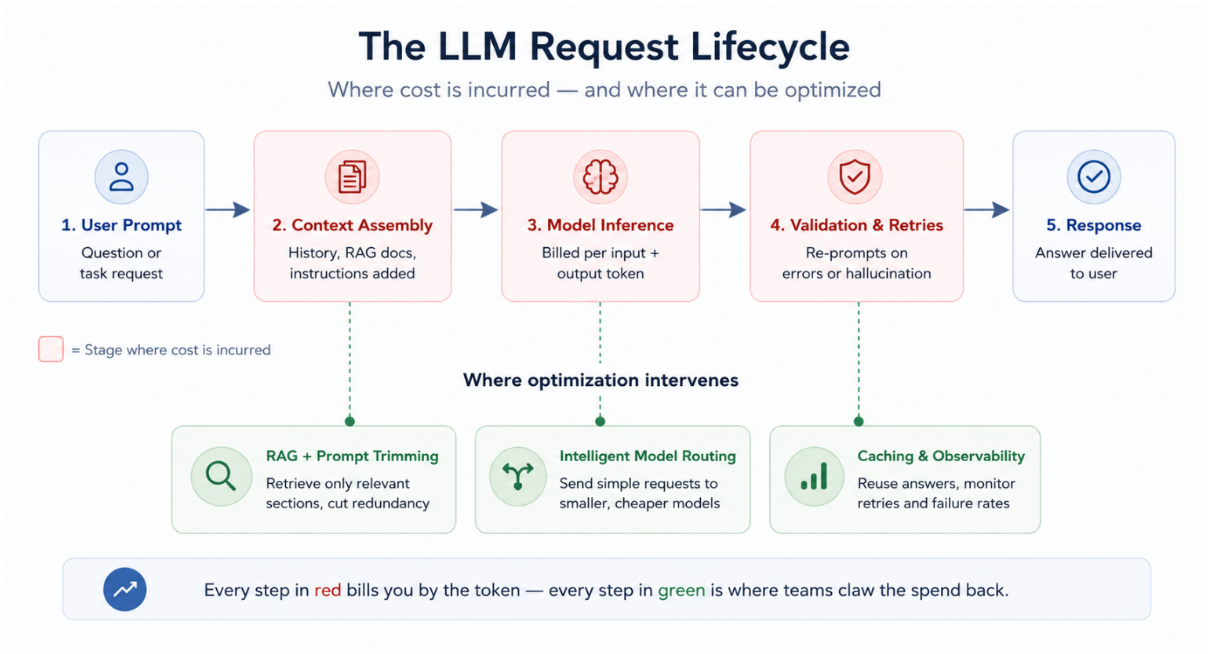
Figure 2: A single LLM request accrues cost at several stages — and each one is also a point where optimization can claw that cost back.
Optimization Techniques That Actually Work
Building a Cost-Aware AI Strategy
A few years ago, organizations started adopting Cloud FinOps because cloud spending was becoming difficult to control. We’re now watching the birth of AI FinOps for the exact same reason.
The goal isn’t reducing costs at all costs that’s usually a disaster. The goal is understanding where money is being spent and whether the business is getting value in return. There’s a huge difference between an AI workflow generating $50,000 in monthly revenue while costing $5,000, and an internal chatbot costing $15,000 every month while barely being used.
True cost-aware AI infrastructure requires granular visibility into:
- Token consumption by application and team
- Model utilization and selection patterns
- Workload efficiency metrics
- Cache hit rates and reuse patterns
- Business outcomes and ROI
- Failure rates and retry patterns
Without visibility, optimization becomes guesswork and guesswork gets expensive fast.
The Techniques That Actually Move the Needle
The funny thing about AI cost optimization is that the biggest savings often come from surprisingly boring engineering practices.
Prompt engineering, for example.
Many enterprise prompts contain redundant instructions repeated thousands of times per day. Teams copy prompts from prototypes, add more instructions during testing, and eventually create giant walls of text that nobody wants to touch because they’re afraid of breaking something.
A careful prompt audit can sometimes reduce token consumption dramatically without affecting quality. Techniques include:
- Removing redundant instructions
- Consolidating examples
- Using more concise instruction formats
- Testing prompt variants systematically
Intelligent model routing is the next lever.
Not every request deserves the same model. A common pattern is sending simple requests to cheaper models and escalating only when complexity rises – think of it as customer support triage, but for AI inference:
- Simple categorization → smaller model (e.g. GPT-3.5, Claude Haiku)
- Moderate complexity → mid-tier model (e.g. Claude Sonnet)
- Complex reasoning → larger model (e.g. Claude Opus), only when needed
Caching helps too.
Organizations are often shocked to discover how many identical questions users ask every day. Why generate the same response a thousand times if the answer hasn’t changed? In practice, this means:
- Storing frequently requested responses
- Using semantic similarity to detect duplicate or similar questions
- Building cached response libraries for common workflows
Retrieval Augmented Generation (RAG) is another major lever.
Instead of shoving massive documents into every prompt, you can retrieve only the relevant sections. Smaller prompts mean lower costs – and often better answers. That’s the part people forget: optimization can improve quality, not just cut spending.
Don’t Forget the Costs Vendor Calculators Miss
Here’s something that rarely appears in vendor pricing calculators:
- Failed requests and retries
- Debugging sessions and prompt experimentation
- Hallucination investigations
- Observability platforms
- Human review workflows
- Engineering time
These costs can become substantial. Teams have spent weeks chasing strange model behavior only to discover a prompt formatting problem buried deep inside an orchestration layer – while dozens of engineers generated thousands of test requests along the way. The AI bill kept climbing. Nobody noticed, because everyone was focused on fixing the problem.
Observability Changes Everything
The organizations managing AI spend successfully all seem to share one habit: they measure everything.
- Token usage by application and by team
- Cost per workflow and per customer interaction
- Latency and cache hit rates
- Model selection patterns
- Failure rates
Without observability, cost optimization feels like playing whack-a-mole in the dark – you fix one issue and three more appear somewhere else. Observability turns AI spending from a mystery into an engineering problem. Engineering problems can be solved. Mysteries usually become executive escalations.
Why This Matters for Your Business
Spending on enterprise AI isn’t decreasing – if anything, we’re still in the early innings. Customer service, software development, analytics, document processing, cybersecurity operations, sales, and knowledge management platforms are all incorporating AI. Usage is exploding, which means cost optimization is no longer optional.
The companies that win won’t necessarily be the ones using the biggest models. They’ll be the ones that understand exactly where their AI dollars are going, and can manage performance, quality, and economics without sacrificing any of them.
That’s the real challenge. Building AI that works is hard. Building AI that works efficiently at enterprise scale is where things get interesting – and it’s where the hidden costs finally stop being hidden.