

Amazon Bedrock • Claude Platform on AWS • AWS Marketplace
Why Choose AWS to Deploy Claude?
Most companies already have dozens of services running on AWS. Adding Claude to that stack — rather than setting up a completely separate vendor relationship — eliminates several headaches at once. There is no second invoice to manage. No extra set of API keys to rotate. No new audit system to learn. Everything plugs into the tools already in place: IAM handles who can access what, CloudTrail captures every model call for audit purposes, and the bill arrives alongside every other AWS charge at month-end.
Beyond convenience, there is a governance angle that matters to security teams. When Claude runs through AWS, the IT department has full visibility. They can see who is using it, how much it costs, and what data flows where — without adding any new monitoring tools. For companies in regulated industries, this kind of visibility is often required, not optional.
That said, “Claude on AWS” is not a single product. There are three different paths, each built for a different situation. Choosing the wrong one means either missing features you actually need or paying for controls you don’t.
Option 1: Amazon Bedrock
When Data Cannot Leave the AWS Boundary
Bedrock handles Claude inference entirely inside AWS infrastructure. Prompts, responses, and any associated data stay within the AWS boundary — Anthropic never processes or sees any of it. For healthcare organizations, banks, government agencies, and any company dealing with sensitive records, this separation often makes the difference between getting a project approved and having it stuck in legal review.
On top of the data handling guarantee, Bedrock bundles several features that would otherwise need custom engineering:
- Guardrails — Content filtering applied at the infrastructure layer. Define what topics are off-limits or how personally identifiable information should be handled, and Bedrock enforces the rules before responses reach the application.
- Knowledge Bases — Built-in retrieval-augmented generation. Connect Claude to internal documents and data sources without having to build separate vector databases or search indexes.
- PrivateLink — All traffic stays on the AWS private network. Nothing travels over the public internet.
- Regional Data Residency — Pick which AWS region processes the data. Helpful when data sovereignty laws require keeping information within a specific geographic boundary.
- Flexible Pricing Tiers — Standard (pay per token), Priority (higher throughput), Flex (lower cost for batch workloads), and Reserved (dedicated capacity with a term commitment).
Bedrock currently supports Claude Opus 4.7, Opus 4.8, and models from the Sonnet and Haiku families. The inference engine was upgraded earlier this year with lower latency and a zero-operator data access model — meaning even AWS operators cannot see prompt or response content.
Best fit: Regulated industries (healthcare, finance, government), workloads with strict data residency rules, teams that need infrastructure-level content filtering or native RAG.
Option 2: Claude Platform on AWS
Full Anthropic Experience With AWS Governance
This option delivers Anthropic’s own platform — identical APIs, developer console, and tooling — while letting AWS handle the identity, payment, and monitoring layers. Teams authenticate with their existing AWS credentials, spending shows up on the standard AWS invoice, and every API call appears in CloudTrail alongside all other AWS activity.
The key difference from Bedrock: requests are processed by Anthropic rather than staying entirely inside AWS infrastructure. Data residency controls like PrivateLink and regional isolation are not part of this path. However, for teams where the governance that matters most is “who has access” and “how much are we spending,” those needs are fully covered.
- Native Anthropic APIs — Code written against Anthropic’s standard SDK works without changes. No translation layer or SDK swaps needed.
- Early Feature Access — New Claude capabilities and beta features typically land here before appearing on Bedrock. Teams that need to stay current get access sooner.
- AWS IAM Sign-in — No separate Anthropic accounts. No personal API keys. Access control lives in the same system the IT team already manages.
- Unified Billing — Claude costs appear on the monthly AWS bill. One invoice, one budget system, no separate vendor payment to track.
- Full CloudTrail Integration — Security and compliance teams audit Claude activity using the same workflows they already run for all AWS services.
A notable addition launched in July 2026: the Claude apps gateway for AWS. Organizations where multiple developers use Claude Code or Claude Desktop can deploy this self-hosted control plane to manage access, spending, and policy from a single dashboard. It eliminates the scenario where every team member has their own credentials with no central oversight.
Best fit: Development teams building on Anthropic’s APIs, organizations that want early access to new features, companies that need AWS-level governance without strict data-within-AWS requirements.
Option 3: AWS Marketplace
Claude for Every Employee, One Subscription
When the goal is putting Claude in front of an entire organization — not just one engineering team — the Marketplace path streamlines both the buying process and the rollout. Procurement follows the same steps as any other AWS Marketplace purchase, which means legal and finance teams already know how to approve it. No separate vendor contract, no new billing relationship to set up.
The primary offering is Claude Enterprise, which bundles all of Anthropic’s tools — Claude Chat for everyday conversations, Claude Code for software development, and Cowork for collaborative workflows — into a single plan. It comes with enterprise security controls, HIPAA eligibility (with a BAA available), and a centralized admin console for managing access across the company.
- Full Tool Bundle — Every employee gets access to Claude Chat, Claude Code, and Cowork. Not just developers, not just one team.
- HIPAA-Eligible — A business associate agreement is available for healthcare organizations or any company handling protected health information.
- EDP / PPA Drawdown — Spending on Claude Enterprise counts toward pre-committed AWS spend. No additional budget line needed in many cases.
- Claude Tag in Slack (Beta) — Tag @Claude in any Slack channel. It picks up context from conversations, accepts tasks from anyone in the channel, and works alongside the team.
- Managed Updates — New model versions and features roll out automatically. No re-provisioning or manual upgrade cycles.
Best fit: Organization-wide deployments, procurement-driven buying processes, companies with AWS committed spend, teams that need the full chat + code + collaboration bundle.
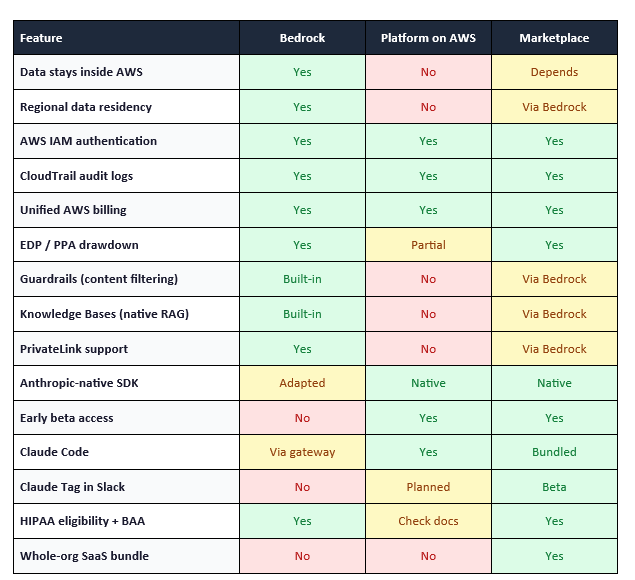
Feature Comparison — At a Glance
How to Decide
Start with one question: Does the data absolutely need to stay inside the AWS boundary? If yes — because of healthcare regulations, financial compliance, government requirements, or internal policy — then Bedrock is the clear answer.
If data residency is not the hard constraint, then the question becomes: who is the primary audience? Development teams that need API access and the latest features should look at Claude Platform on AWS. If it is the entire company — marketing, sales, ops, support, everyone — then Marketplace with Claude Enterprise is the cleaner path.
These three options also work together. Many organizations use Bedrock for compliance-sensitive production workloads, Claude Platform on AWS for their development teams, and Marketplace for company-wide employee access. Different problems, different tools, no overlap.
Choose Amazon Bedrock when:
- Data sovereignty or compliance is required.
- Content filtering and RAG are needed at the infrastructure level.
- The Industry is healthcare, finance, or government.
- Network traffic must stay off the public internet.
Choose Claude Platform on AWS when:
- Developers are already using the Anthropic SDK.
- Early access to new features and betas matters.
- Need SSO and billing control but not data isolation.
- Central management of Claude Code and Desktop is a priority.
Choose AWS Marketplace when:
- Rolling out Claude to the whole company, not one team.
- Legal and procurement need a standard buying process.
- Want the full suite: chat, code, and collaboration tools.
- AWS committed spend (EDP/PPA) should offset the cost.