
Let me say something that might sting a little.
AI will not replace QA engineers. However, those who learn to use AI effectively will work faster than those who do not.
I have watched this change happen on real teams.
Manual testers who use tools like ChatGPT, Microsoft Copilot, or Claude in their daily work are getting better results, faster. It is not because they have become developers overnight. Instead, they use AI early on to draft ideas, organize their thoughts, review scenarios, and communicate more clearly.
At the same time, teams that still treat testing like a copy-and-paste exercise in spreadsheets are starting to fall behind. Not overnight. Not in some dramatic way. But enough that the difference shows up in the quality of their work, the speed of their response, and the confidence they build with developers and stakeholders.
And that is the part many people miss.
The real gap is not only speed. It is clarity, coverage, and the quality of feedback.
You Do Not Need to Be an AI Expert
Here is the practical truth.
- You do not need to train a model.
- You do not need to become an AI researcher.
- You do not need to become a full-time coder.
What you do need is a better mindset.
Use AI like a smart teammate.
Not as a machine that gives final answers. Not as a shortcut for lazy work. Use it as a drafting partner, a brainstorming assistant, and a second pair of eyes that helps you move faster while you still own the judgment.
That is where human value stays strong.
AI can help you think faster. You still decide what matters, what is risky, and what is actually correct.
What AI Looks Like in Manual QA
If you are doing manual testing today, AI can start helping you in practical ways almost immediately. This is what AI-assisted QA can look like in day-to-day work.
1. Draft Test Cases Faster
Starting from a blank page slows everyone down.
Instead of writing every test case from scratch, you can describe the feature, the goal, and the expected behaviour. AI can give you a solid first draft with:
- Test scenarios
- Happy paths
- Negative flows
- Edge cases
- Validation points
Then your job is to review it, adapt it to your product, and make sure it matches real user behaviour and real business requirements.
2. Write Bug Reports Developers Trust
A lot of back and forth happens because bug reports are incomplete.
AI can help you write:
- Clearer reproduction steps
- Expected versus actual behavior
- Environment details
- Possible root-cause clues
It can also suggest what extra information a developer is likely to ask for next.
That means fewer follow-ups, less confusion, and faster fixes.
3. Generate Test Data Quickly
Good testing needs good data, and creating it manually can take too much time.
AI can help generate realistic test inputs in minutes. That includes:
- Valid and invalid customer data
- Boundary values
- Localization strings
- Complex combinations of form inputs
You still need to verify what your UI, API rules, and business logic actually support. But you are no longer starting from zero.
4. Improve Exploratory Testing
This is where strong testers really stand out.
AI can help you come up with ideas you may not think of right away, especially when you combine it with your own product knowledge.
You can ask it to suggest:
- High-risk areas based on similar features
- Failure modes
- “What could go wrong” scenarios
- Usability issues and flow interruptions
- Cross-browser or cross-device risks
It helps you widen your thinking. You still do the real exploration.
5. Spot Requirement Gaps Earlier
One of the most valuable things QA can do is catch unclear requirements before they turn into production defects.
AI can help you turn messy requirements into:
- Checklists
- Assumptions
- Clarification questions
- Missing states
- Weak error handling scenarios
- Undefined edge cases
That gives you a better chance to push for clarity before development moves too far.
6. Learn Automation Faster
If you want to move toward automation, AI can make the learning curve less painful.
It can help you draft:
- Test coverage ideas for automation
- Automation approach notes
- Candidate test cases for scripting
- Selector strategies
- Maintenance considerations
You still have to learn the fundamentals. But you do not have to learn them alone or start with a blank screen every time.
7. Write Reports People Can Actually Understand
A lot of test reports miss the mark. They are either too vague to be useful or too technical for stakeholders to follow.
AI can help you turn raw testing notes into clear summaries that explain:
- Coverage
- Risk
- What changed
- What is blocked
- What matters next
That makes it easier for managers, product owners, and stakeholders to make decisions without digging through unnecessary detail.
The Real Skill Is Not Just Using AI. It Is Using It Well.
The best testers are not the ones who simply open an AI tool.
They are the ones who know how to prompt clearly, review carefully, and challenge the output when something feels wrong.
AI can generate text quickly. What it cannot do by itself is understand:
- Your full product context
- Your business rules
- Your environment
- Your team standards
- Your definition of done
That part still belongs to you.
A good habit looks like this:
- Ask for structured output
- Provide product context
- Review the result critically
- Run the scenario yourself
- Confirm everything with evidence
That is how quality stays real.
The Best Results Come from Human Judgment Plus AI Speed
The goal is not to hand your thinking over to AI.
The goal is to increase your output without lowering your standards.
When you combine human judgment with AI speed, testing becomes:
- Faster to start
- Faster to refine
- Easier to explain
- Harder to get wrong
- More aligned with what QA actually need
That is how QA evolves.
Not by disappearing, but by becoming more valuable.
Your Career Is Not Ending. It Is Changing.
A simple way to look at the journey is this:
Manual Tester today → AI-Aware Tester next → Agentic QA Engineer after that
This is not about becoming an AI engineer overnight.
It is about improving:
- How you work
- How you think
- How much value you bring to the team
As you grow, your role starts to shift:
- From executing test cases
- To designing better coverage
- To improving bug quality and communication
- To speeding up test strategy
- To creating stronger feedback loops across the product team
That is how people move forward in QA now.
A Simple Roadmap for What to Learn Next
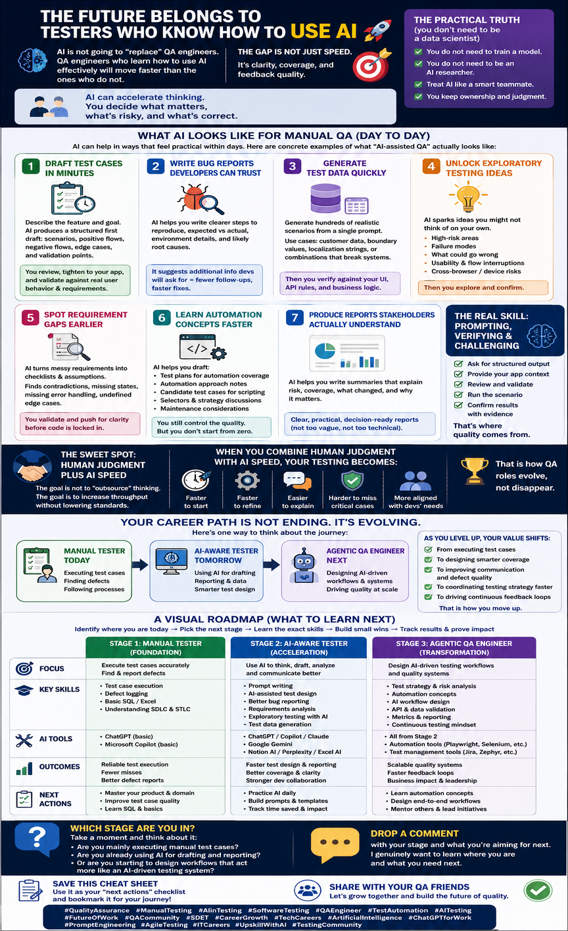
I created an infographic that shows the path from manual testing to AI-aware QA and then toward agentic QA. It breaks down the skills, tools, and learning steps along the way.
If you use it as a practical checklist, here is how to make it useful:
- Identify where you are today
- Choose the next stage you want to reach
- Learn the skills that matter for that stage
- Apply them in small ways in your daily work
- Track results so you can show real impact
Which Stage Are You In Right Now?
Take a minute and be honest with yourself.
- Are you mostly executing manual test cases?
- Are you already using AI to draft, review, or report faster?
- Or are you starting to design workflows that feel more like an AI-driven testing system?
Manual to AI QA Engineer Complete Career Journey Cheat Sheet below: