

Risk-Based Testing with Artificial Intelligence in IoT Projects

How QA Teams Can Finally Test What Matters First

Dedicate time to any IoT Project, and you will unavoidably reach the turning point where the test suite is too huge for a sprint cycle.  

Testing just one layer isn’t enough. We must validate the entire system, from the firmware and hardware protocols to the edge gateways, cloud backends, and dashboards at the same time.  

While a bad web deployment might cause temporary downtime, a faulty OTA firmware update in an IoT can break thousands of physical devices in the field. 

A disconnected MQTT broker can freeze an entire sensor network until the hardware is manually reset. 

A common question from IoT QA Engineers is that, if you are struggling to manage over a thousand automated checks within sprint deadlines, you are not alone. Discover how integrating AI risk-based analysis shifts your focus from running every single test case to executing the tests that matter most. 

The Real Problem with IoT Testing Today
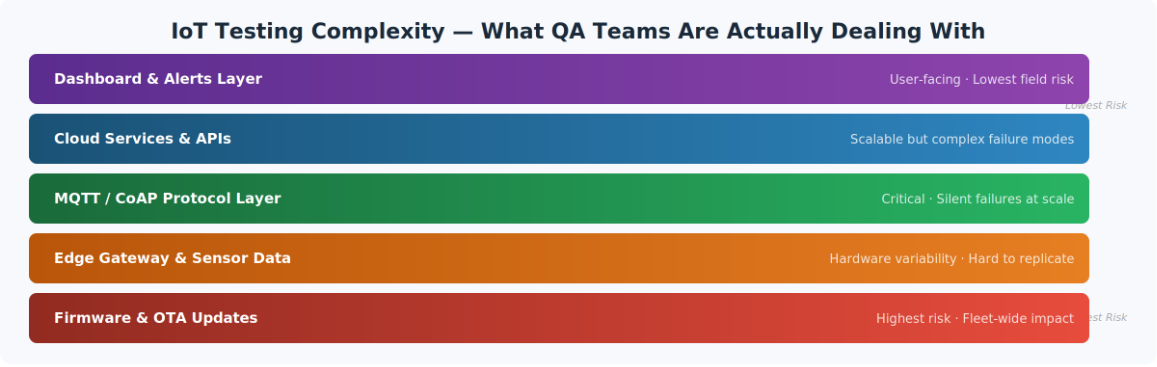
Figure 1 — IoT testing spans five distinct layers, each with different failure modes and field impact

Most IoT QA teams fall into one of two habits when time is running out. Either they rush through the full suite and accept that some things get a surface-level pass, or they informally skip lower-priority test cases and rely on the senior tester’s instinct to catch what matters. Both are understandable given the constraints. Neither is great.

The informal approach works better than it sounds, an experienced QA person develop a decent radar for risk. The problem is that it is not consistent. It depends on what happens in that sprint, what they remember from the last release incident, and whether they have time to look at recent commit activity. That is not a scalable process.

In IoT, a defect that escapes to the field carries a cost that functional teams rarely face. Unexpected device behavior, corrupt sensor readings, or the device needs an on-site manual reset — the business impact of a missed critical bug is orders of magnitude higher than most other software domains.

Why AI Handles IoT Risk Prioritization Better Than Humans Can Alone

Risk-based testing works reasonably well for web applications because the dependency is manageable and most of the relevant context is available in a few places. IoT breaks that.

Dependency runs deeper, hardware introduces inconsistency that software testing cannot always replicate, and the data you need to make a good risk decision is scattered – some in Git, some in Jira, some buried in field telemetry logs that nobody has time to read before standup.

No single person can process a massive web of variables simultaneously, making this the perfect problem to offload to AI.

Rather than trusting strictly to memory and subjective judgment, teams can pull modification history, component-specific bug metrics, and field incident logs into an algorithmic framework that assigns a risk score to all testing areas at the start of every sprint.

The technology is not a replacement for the skilled tester, but it is giving that tester a faster, more consistent starting point.
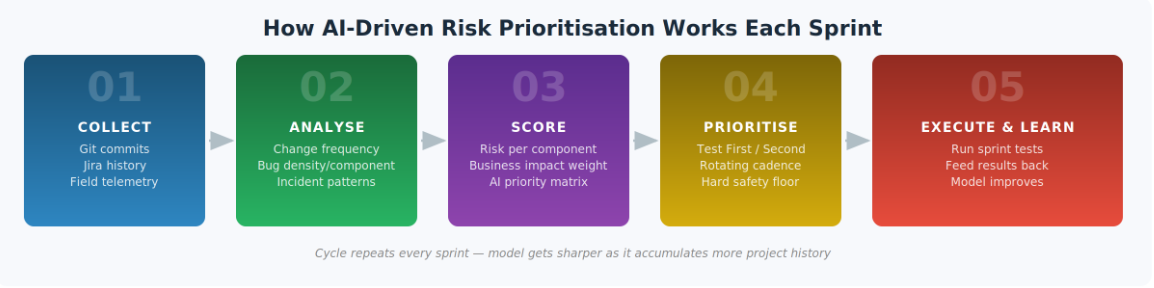
Figure 2 — The five-step AI prioritizsation loop, executed at the start of each sprint 

How AI-driven priority matrices function in reality

Here is an example of how components might shake out for a typical connected device platform, scored on business impact and current failure risk: 

IoT Component Business Impact Failure Risk AI Priority
Firmware OTA Updates Critical High Test First
MQTT / CoAP Layer Critical High Test First
Device Auth & Security Critical Medium Test First
Sensor Data & Thresholds High High Test Second
Edge Gateway Failover High Medium Test Second
Dashboard Alerts Medium Medium Test Later
Device Provisioning Medium Low Test Later
Historical Reporting Low Low Lower Priority

Nothing in that top should surprise anyone, OTA and authentication have always been obvious checks. Instead of someone manually assembling this picture at the start of each sprint, the AI does it automatically based on actual change data from that test cycle. The team stops discussing what to prioritize and starts testing. 

What collaborative units can logically project as their return?
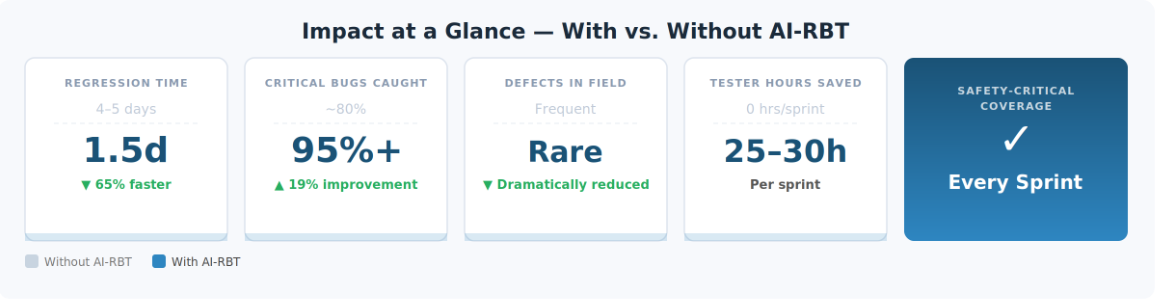
Figure 3 — Key metrics from teams that have adopted AI-driven risk-based testing 

Reducing from 500+ tests to roughly 200 per sprint does not mean ignoring the rest. It means the highest-risk test cases run every single sprint without exception, while lower-risk test cases rotate in on a scheduled basis. Nothing gets permanently dropped - it just gets scheduled more intelligently.

A Few Things Worth Being Honest About

I have seen a couple of teams oversell AI-based prioritization internally, only to face disagreement when reality pushed back. A few conditions should be made clear at the very beginning: 

  • Exploratory testing still has its place. The framework surfaces a likely failure framework based on historical patterns. It does not catch novel failure modes that nobody has seen before — that is still driven by humans. 
  • Some hardware testing must happen physically. Risk scores cannot substitute for running a device through its thermal or connectivity edge cases on the bench. 
  • Safety isn’t a variable, it is a strict baseline. You must define an absolute minimum coverage level for anything that is safety-related, and that limit should never be negotiable based on AI scores. 
  • Garbage in, garbage out: if you feel a framework is messy, untagged, or incomplete history, do not expect it to magically produce structured or accurate outputs without specific data preparation. 

Does this make good business sense?

The Answer is YES, most IoT teams are handling test suites against tighter release cycles. AI is not Magic. It is a Data Discipline How to Build Real Value. The methods are standard, and the required information is already sitting in most team members systems. The true challenge is simply deciding to bridge those gaps. 

The fragmented hardware of the IoT domain means field bugs are incredibly expensive; this is exactly where data-backed prioritization yields the highest returns 

Teams that have made this shift tend not to go back to informal approaches not because AI is magic, but because having a transparent, structured system is essential when things crash in the middle of the night. 

The blueprint for the AI-native enterprise,
delivered to your inbox.

    Read Next

    Related Insights

    ×