

Architecture for Governance, Observability, Security and Lifecycle Management of AI Agents
A forward-looking perspective for AI engineers, architects and technology leaders
Introduction
There is a funny thing happening in enterprise AI right now. Teams are getting very good at building agents, but many organizations are still figuring out how they will live with all of those agents once the experiments turn into production systems.
A few years ago, the conversation was mostly about chatbots and copilots. Then agents arrived. An agent could reason over a task, call tools, retrieve information, make a decision and carry the work forward. That changed the shape of enterprise automation.
The next step was almost inevitable: put several specialists together. A planning agent could hand work to a coding agent, which could involve a testing agent, a documentation agent and eventually a deployment workflow. Multi-agent systems made complicated tasks easier to break apart.
But there is a second-order problem hiding underneath that success. If every team keeps creating agents, the organization eventually ends up with an AI library nobody can properly see, understand or control.
That is the problem I believe the next enterprise AI layer will need to solve: not how to create another agent, but how to operate an entire population of them. This article looks at the Meta-Harness as an enterprise control plane for managing and governing AI agents.
The evolution of enterprise AI
The progression is worth looking at because it explains why this new layer is becoming necessary.
Phase 1 — Individual AI applications
The first wave was straightforward. Organizations added AI to individual applications: a support assistant, a document summarizer, a coding helper or an internal knowledge bot. Each application had a clear boundary and usually had one team responsible for it.
Phase 2 — Agentic AI
Then the boundary moved. Instead of simply generating an answer, an AI system could plan a task and act on it. Agents could reason, use tools, remember context and complete a sequence of steps. The value was no longer just better answers; it was getting work done.
Phase 3 — Multi-agent systems
Complexity pushed teams toward specialization. Rather than asking one agent to do everything, organizations started creating groups of agents with narrower responsibilities.
- Planner or coordinator agent
- Coding or implementation agent
- Testing and quality agent
- Documentation agent
- Deployment or operations agent
An orchestrator can coordinate those agents very effectively. For a particular workflow, this is exactly what you want. The problem appears when the same pattern is repeated across the entire organization.
The problem waiting after success: agent sprawl
Imagine an enterprise two years into a serious agent adoption program. Engineering has its own agents. Data teams have built others. Finance, customer support, compliance and operations have followed. There are also small experimental agents that started as proofs of concept and quietly became useful internal tools.
Now ask a simple question: how many agents do we actually have?
In many organizations, that answer will not be as easy as it sounds.
Different teams may use different frameworks. Some agents are custom applications. Others are built on shared agent frameworks. Their prompts, tools, memory, permissions, evaluations and deployment processes may all be managed differently.
This creates a form of technical debt that is easy to overlook because the individual projects look successful. I would call it agent management debt.
The more agents an organization adds, the more important it becomes to know what exists, who owns it, what it can touch, how well it performs, how much it costs and whether another team has already built something similar.
Why another master agent is not the answer
One tempting response is to build a bigger agent above the other agents. It sounds elegant: one master agent understands the request and delegates the work.
That can be useful, but it does not solve the enterprise management problem.
An orchestrator is primarily concerned with execution. It decides which agent should run, what tool should be called, how outputs should move through a workflow and what to do when a step fails.
Enterprise governance asks a different set of questions.
- What agents exist across the organization?
- Who is responsible for each one?
- Which version is currently deployed?
- What data and tools can the agent access?
- Which policies apply to it?
- How is its quality being evaluated?
- What is it costing the organization?
- When was it last reviewed?
- Is another team already solving the same problem?
- Should it be upgraded, restricted or retired?
Those questions sit above the workflow. They are operational, security and governance concerns. Trying to solve all of them by making the orchestrator larger mixes two different responsibilities.
A useful analogy is Kubernetes. A deployment script can start containers, but that does not make the script a cluster management platform. The abstraction matters.
So, what is a Meta-Harness?
A Meta-Harness is an enterprise control layer for the AI agent ecosystem.
It does not replace the agents. It does not require every team to abandon the frameworks they already use. And it does not mean every workflow suddenly has to pass through one giant orchestrator.
Instead, the Meta-Harness sits above the agent estate and gives the organization a common way to discover, govern, secure, observe, evaluate and manage those agents.
The distinction is important: an orchestrator coordinates a job; a Meta-Harness manages the environment in which those jobs and agents exist.
Enterprise AI Meta-Harness architecture
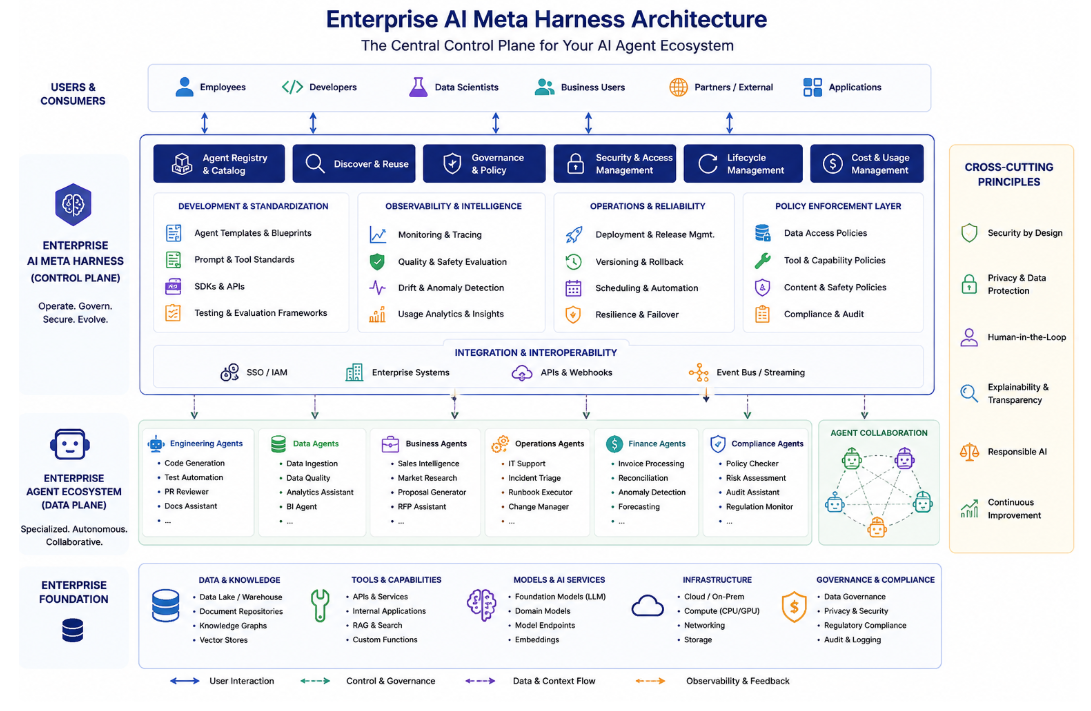
Figure 1. Enterprise AI Meta-Harness — a control plane above specialized agent ecosystems, with enterprise data, tools, models and infrastructure underneath.
The architecture illustrates the main idea. Agents remain specialized and can continue to collaborate within their workflows. The Meta-Harness provides the common layer around them: registry, discovery, governance, access control, lifecycle management, observability, cost management and enterprise integration.
What changes when the Meta-Harness exists?
1. The organization gets an agent registry
The first improvement is visibility. Every production or approved experimental agent can have a recognizable identity and record: its owner, purpose, deployment status, model, tools, permissions, dependencies and lifecycle stage.
This sounds basic. It is also one of the first things organizations lose when AI development becomes decentralized.
2. Governance moves closer to the platform
Teams should still be free to innovate, but the rules around production AI should not be reinvented by every team.
- Approved model and tool policies
- Prompt and configuration standards
- Evaluation gates before release
- Safety and content policies
- Approval and audit workflows
- Compliance controls
The result is not less innovation. Done well, it is less friction around responsible innovation.
3. Security becomes an ecosystem concern
An agent that can read customer information or call a production API is very different from a simple internal summarization assistant. Treating them as if they have the same access is a mistake.
A Meta-Harness can provide a common policy layer for identity, authorization, data access and tool permissions. The goal is straightforward: an agent should receive only the capabilities it actually needs.
4. Observability stops being fragmented
Agent quality cannot be judged from a single successful demo. Production systems need a broader picture.
- Latency and failure rates
- Token and model usage
- Tool-call behavior
- Quality and evaluation results
- Drift and anomalous behavior
- Business outcomes
- AI spend
When these signals are collected consistently, engineering leaders can compare agents, identify weak points and make investment decisions with something better than anecdotal evidence.
5. The agent lifecycle becomes manageable
Agents are software, but they also behave like evolving decision systems. A model change, prompt change, tool change or data change can alter their behavior.
That makes lifecycle controls particularly important: versioning, testing, staged rollout, rollback, review, deprecation and retirement should be normal platform capabilities rather than custom work in every project.
6. Reuse becomes easier to find
Without a shared catalog, teams can spend weeks rebuilding something another team already has.
A Meta-Harness can make useful capabilities discoverable: approved connectors, tools, agent templates, prompts, evaluation assets and reusable components. The value is not just saving code. It is helping people discover what the organization already knows how to do.
Meta-Harness vs. multi-agent orchestration
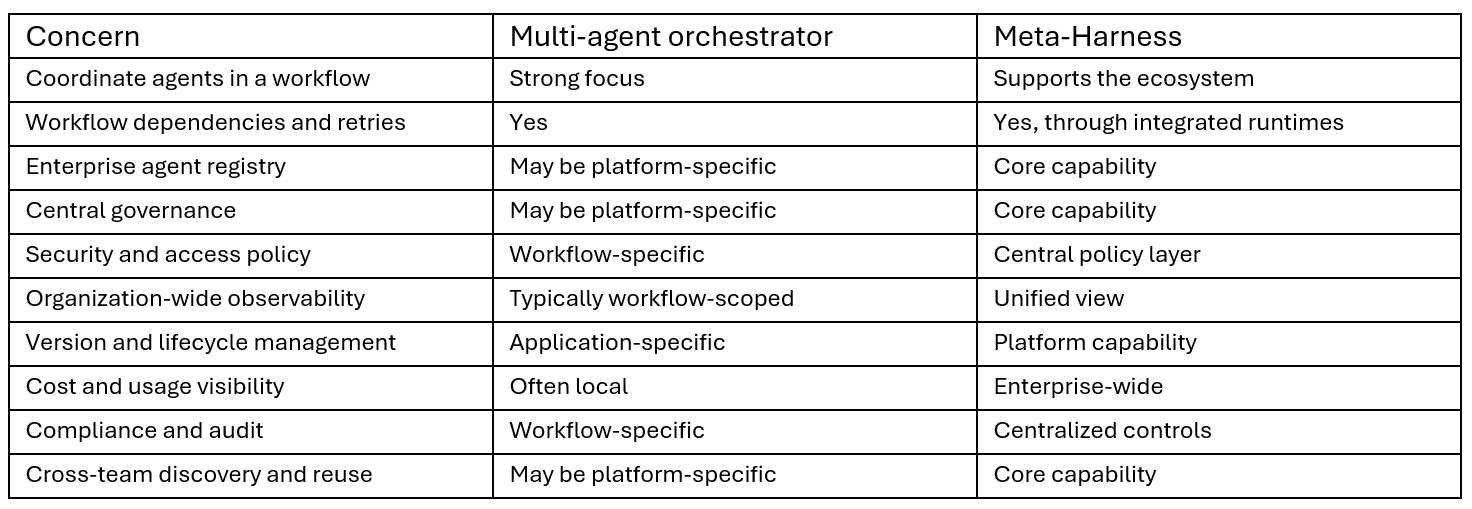
Capabilities vary by platform and may overlap.
The point is not that one is better than the other. They solve different problems. Orchestration is about coordinating work. The Meta-Harness is about making an organization’s entire agent estate manageable.
The bigger advantage: turning an agent collection into an AI platform
This is where I think the Meta-Harness idea becomes more interesting than simply adding another technical component.
Without a common management layer, an organization’s AI capability looks like a collection of projects. With one, it starts to look like a platform.
That shift has practical consequences. An engineering leader can ask which agents are actually delivering value. A security team can see which agents have access to sensitive systems. A platform team can identify duplicated capabilities. Finance can understand where model spend is going. Product teams can discover existing AI capabilities instead of starting from zero.
In other words, the organization starts treating AI capabilities as shared assets rather than isolated experiments.
A new enterprise AI operating model
There is a broader change happening here.
The first AI question was: ‘Can the system answer this?’
The agentic question became: ‘Can the system do this?’
The next enterprise question is likely to be: ‘Can we run all of these AI systems safely and effectively?’
That last question is less glamorous than a new model release, but it may matter more to organizations trying to move AI from experiments into a durable operating model.
Why this could be the next important AI trend
Technology history tends to repeat one pattern: once a new capability becomes easy to create, management becomes the next bottleneck.
Virtual machines led to the need for virtualization management. Containers led to orchestration and platform engineering. Microservices created demand for observability, service discovery and policy layers.
AI agents are now reaching the same point. Creating one is becoming increasingly accessible. Creating hundreds is not the hard part. Running hundreds responsibly is.
That is why I see the Meta-Harness as a likely next-stage enterprise architecture rather than simply another agent framework.
The organizations that prepare early will have an advantage
There is a practical reason to pay attention to this trend now. Platform decisions made during the early stage of AI adoption are much easier to influence than platform decisions made after hundreds of agents are already in production.
Organizations that establish an agent registry, common identity model, policy framework, evaluation process and observability standards early can scale without having to retrofit everything later.
That does not mean buying or building a massive platform on day one. It means recognizing the direction of travel and designing today’s agent projects so they can eventually participate in a common control plane.
Final thought
The Agentic Era changed the role of AI. AI systems are no longer limited to generating information; they can participate in real work.
The next challenge is less about proving that agents can act and more about proving that an enterprise can trust and operate them at scale.
That is the space the Meta-Harness is designed to address.
I do not expect the Meta-Harness to make orchestration disappear. Quite the opposite. Orchestration will remain important inside individual workflows. The difference is that orchestration will become one capability inside a larger enterprise AI control plane.
If the current decade is remembered as the decade when AI became agentic, the next phase may be remembered for something less flashy but just as important: organizations finally learning how to run their AI workforce.
The question is no longer whether enterprises will build agents. They already are.
The more interesting question is whether they will build the layer needed to manage what comes next.