

Every enterprise I talk to is racing to make their data platform “AI-ready.” They are evaluating agent frameworks, standing up vector stores, wiring LLMs into business workflows. Almost none of them are talking about governance.
That is the gap that will decide who succeeds. Because here is what most teams discover the hard way: an AI agent cannot use data it cannot discover. It cannot judge whether a number is trustworthy without a quality signal. It cannot explain where an answer came from without lineage. And it cannot be allowed near sensitive data without policy enforcement it can actually read.
Every one of those capabilities is a governance capability. Governance is no longer the compliance function that slows the platform down. It is the machine-readable trust layer that makes AI usable at enterprise scale. Without it, you do not have an AI-ready platform — you have a very expensive way to generate confident, unverifiable answers.
A CDO recently asked me a question that I think every data leader should sit with: “We have built the catalog, connected the lineage, stood up the governance council. But business teams are not using any of it. What are we doing wrong?”
The answer, in my experience, is almost always the same: governance was built for the data team, not for the business — and now, not for the machines either. The catalog is populated with technical metadata that business users ignore and LLMs cannot interpret. The lineage is complete but nobody outside data engineering has ever looked at it. The marketplace exists but has no customers, human or agentic. The governance council meets bi-weekly but business stakeholders stopped attending after month two.
This is the governance failure pattern I see most often — and it is the hardest to fix because the technology is working perfectly. The problem is adoption. And in the AI era, there are now two audiences you have to win: your business users, and the AI systems acting on their behalf.
Governance Is the AI-Readiness Prerequisite
Let me be specific about why this matters more now than when most governance programs were designed. When a human analyst works with ungoverned data, they compensate. They ask a colleague which table is the right one. They notice a number looks wrong and investigate. They know from experience that the Finance extract is more reliable than the Operations copy. Human judgment fills the governance gap.
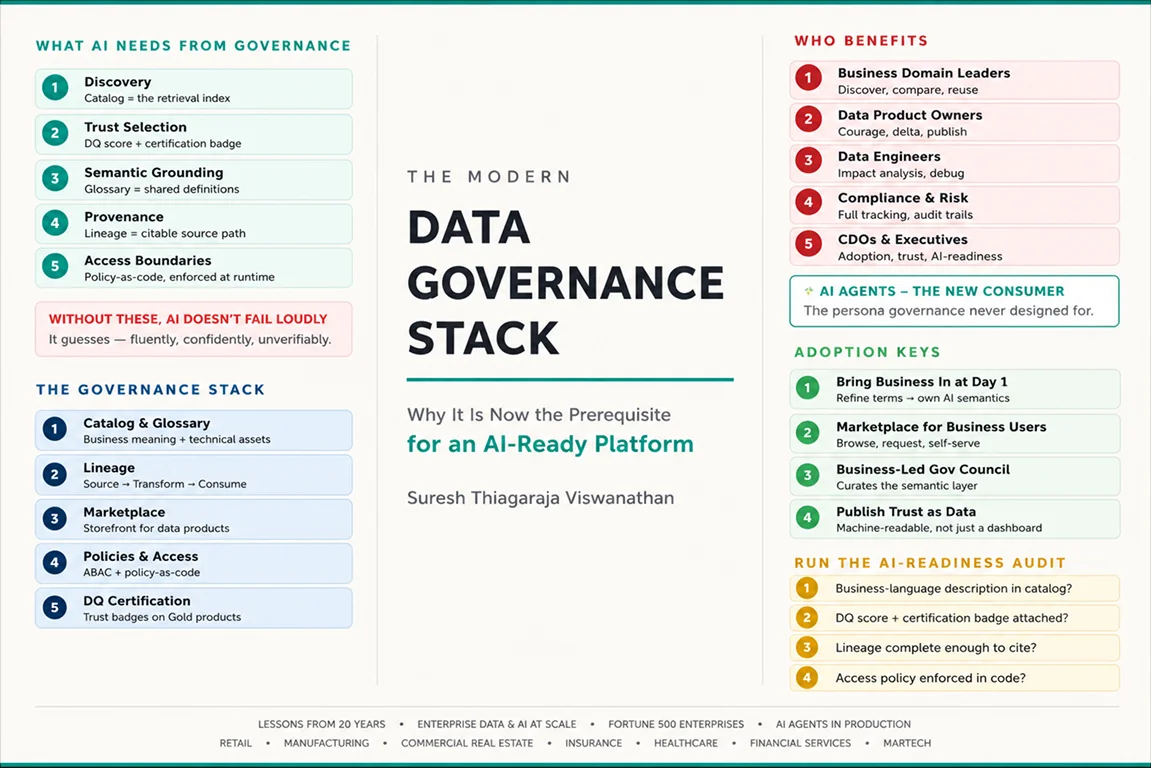
AI systems have no such judgment. An LLM or agent operating over your data platform depends entirely on the metadata you expose. Consider what an agent actually needs in order to answer a business question reliably:
- Discovery: The agent must be able to find relevant data assets. Without a catalog exposing business-meaningful descriptions, the agent is searching table names and column headers. It will confidently retrieve the wrong asset because it has no way to know a better one exists.
- Trust selection: When five tables contain something called “revenue,” the agent must choose. A human might ask around. The agent needs a machine-readable signal — a DQ score, a certification badge, an authoritative-source flag. Without one, it picks arbitrarily, and arbitrary is indistinguishable from wrong.
- Semantic grounding: The agent must understand what “net occupancy” means in your organization, not what it means generically. That definition lives in the glossary. Without it, the agent substitutes its training-data assumption — which is a hallucination wearing the costume of a fact.
- Provenance: When the agent gives an answer, the user needs to know where it came from. Lineage provides that citation path. An answer without provenance is an answer no executive should act on.
- Access boundaries: The agent must be constrained to what the requesting user is entitled to see. Policy-as-code enforces this computationally. Documentation-based policy does not survive contact with an autonomous system.
Governance metadata used to be documentation for humans. It is now the runtime context layer that AI systems depend on — which means incomplete governance is no longer a compliance gap, it is an accuracy defect.
This reframing changes the business case entirely. Governance investment used to be justified defensively — audit readiness, regulatory exposure, risk reduction. Now it is justified offensively: it is the precondition for every AI capability on your roadmap. The organizations that governed well over the last three years are deploying agents today. The ones that deferred governance are discovering that they cannot.
Why Business Teams Should Care About Data Governance
Before we go deeper into catalogs and lineage, let us establish why any business leader should care. The value proposition is not compliance. It is not metadata management. It is this: governance is how business teams — and the AI systems working for them — find, trust, understand, and safely use data to make better decisions faster.
Consider the questions that business teams ask every day:
- “Where do I find customer data for my region?” — That is discovery. The catalog and marketplace answer it, for humans and for agents.
- “Which revenue number should I use — the one from Finance or the one from Operations?” — That is semantic clarity. The glossary and certification badges answer it.
- “If I change this calculation, what downstream reports will break?” — That is impact analysis. Lineage answers it.
- “How much of the data I need for my new product already exists on the platform?” — That is coverage and reuse. The marketplace answers it.
- “Can I trust this number enough to present it to the board — or to let an AI assistant answer questions about it?” — That is trust. DQ certification badges and quality scorecards answer it.
When governance is framed this way — as the system that answers these questions for both people and machines — business engagement follows naturally. When it is framed as “metadata compliance” or “stewardship workflows,” business teams disengage. The frame determines the outcome.
Governance as the Operating System of the Data Platform
Governance fails when it is treated as paperwork. It works when it becomes the operating system of the data platform: the catalog as the front door, the marketplace as the storefront, lineage as the nervous system, and policies enforced by design — not by email.
Modern governance is product-centric. Every data product — table, feature set, semantic view, API — has an owner, SLA, access policy, quality contract, lineage, and business context. The governance stack ties these together so producers and consumers — human and machine — can work quickly and safely.
Catalog and Glossary: The catalog is where technical assets meet business meaning. Authoritative business terms in the glossary are linked to physical assets in the catalog. Search finds concepts, not just tables. When a business user searches for “net revenue,” they find the governed definition, the calculation logic, the source lineage, the quality score, and the DQ certification status — not a list of 47 tables with “revenue” in the name. The same structure is what an LLM needs: the catalog is effectively the retrieval index for every AI system that touches your platform, and the glossary is the semantic dictionary that prevents the model from substituting its own definition for yours.
Lineage: End-to-end flow from source through ingestion, transformation, quality gates, to published product and downstream consumption. Lineage serves multiple personas: data engineers use it for impact analysis when managing change or debugging issues; data product owners use it to trace how a specific metric is calculated and from which sources; compliance teams use it to track PII from source through every transformation; executives use it to understand why Finance reports 92% net occupancy while Asset Management reports 95% — lineage shows the divergence point. And increasingly, lineage is what lets an AI-generated answer carry a citation: not just “revenue was $4.2M” but “sourced from the certified Finance Revenue product, refreshed 4 hours ago, derived from these three systems.” That provenance is the difference between an answer an executive can act on and one they have to go verify.
Marketplace: The storefront for governed data products. This is where domain teams publish their products with descriptions, SLAs, quality scores, sample data, and access request workflows. The marketplace answers the critical reuse question: when a data product owner starts building, they can see how much of what they need already exists on the platform — do they have 75% coverage or 10%? This changes the economics of every new domain delivery. Teams request access through the marketplace with policy checks enforced automatically — PII masking, role-based access, and approval routing to the right owner. No emails, no ad hoc Slack messages, no shadow copies. And as AI assistants become the interface through which people ask for data, the marketplace becomes the curated inventory those assistants recommend from.
Policies and Access: Attribute-based access control with policy-as-code. Data security is managed at the platform level — marketplace access to data products is controlled, certified, and auditable. Policies are enforced computationally, not through governance documents that nobody reads. When a policy changes, it propagates automatically across every affected product. This matters enormously the moment autonomous agents enter the picture: an agent will do exactly what it is permitted to do, at machine speed, without pausing to consider whether it should. Policy-as-code is the only form of access control that holds up under that pressure.
DQ Contracts and Certification: Promotion gates per medallion layer with DQ certification badges on Gold products. Consumers see the certification status before they use the data. Certified data earns trust; uncertified data gets questioned. This is the mechanism that drives adoption — when business users know they can trust what they find, they stop building shadow spreadsheets. It is also the single most important machine-readable trust signal you can publish: when an agent has to choose among competing assets, the certification badge and quality score are what let it choose correctly rather than arbitrarily.
How Different Personas Interact with Governance
A governance stack that only serves data engineers is a governance stack that fails. Every persona in the organization should find value in the governance layer — and there is now one more persona in the list that most programs have not accounted for:
Business Domain Leaders: Discover what data exists across the platform. Understand coverage by domain — what percentage of their domain’s data is already governed, profiled, and available. Compare metrics across teams (“Why does Finance’s net revenue differ from Marketing’s?”). Browse the marketplace to find data products for new use cases without filing IT requests.
Data Product Owners: Assess the delta — when building a new data product, how much already exists and can be reused versus what needs to be built from scratch. Understand quality scores and certification status of upstream dependencies. Publish their own products with SLAs, descriptions, and sample data. Track consumption and adoption of their products.
Data Engineers: Impact analysis through lineage — before changing a pipeline, see every downstream consumer that will be affected. Debug data issues by tracing values upstream through every transformation. Manage schema changes with visibility into who depends on what.
Data Source Owners: Track where their source data is used across the platform — which products, which consumers, which models. Monitor PII propagation — see exactly where sensitive fields from their source system end up. Quick-view sample data (synthetic where appropriate) to verify that downstream representations match source intent.
Compliance and Risk Teams: Audit PII and sensitive data flows end-to-end. Verify that access policies are enforced computationally, not manually. Trace data lineage for regulatory reporting requirements. Review governance council decisions and policy change history. With AI in the picture, this extends to a new question: which models and agents consumed which data products, under whose entitlements?
Executives and CDOs: Scorecard-level view of governance maturity by domain. Coverage metrics — what percentage of the platform is cataloged, governed, and certified. Adoption metrics — are business teams actually using the marketplace and consuming governed products? Trust metrics — DQ certification trends over time. And the newest board-level metric: what share of the platform is actually AI-ready?
AI Agents and Assistants (the new consumer): This is the persona most governance programs were never designed for. Agents consume the catalog as a retrieval index, the glossary as a semantic dictionary, DQ scores and certification badges as trust signals for asset selection, lineage as a provenance trail for citations, and policy-as-code as an access boundary. Every one of these is metadata your governance stack either publishes in machine-readable form or does not. If it does not, your agents are guessing — and they will guess fluently.
Business Engagement and Adoption — The Make-or-Break Factor
I was recently asked by a CDO: “How do I get business teams to actually use the governance platform?” I appreciate the question because it reveals the right mindset — a CDO who understands that governance is not complete when the technology is deployed. It is complete when business teams are using it to make better decisions.
Here is the reality: if business teams are not engaged from the beginning — from definition workshops, from glossary creation, from marketplace design — the governance platform becomes a shiny toy sitting in a corner. The catalog fills up with metadata nobody reads. The glossary contains definitions nobody ratified. The marketplace lists products nobody browses. I have seen this happen multiple times, and the recovery is harder than getting it right the first time.
The AI era raises the stakes on this. An unadopted governance platform used to be wasted investment. Now it is also a blocked AI roadmap — because the definitions business never ratified are exactly the definitions your agents need, and the products nobody certified are exactly the products your agents cannot safely use.
The engagement playbook that works:
- Bring business in at Day 1 of governance design. Not Day 30. Not after the catalog is populated. Day 1. Business domain leaders should co-define the glossary terms, validate the marketplace categories, and approve the governance council charter. If they help build it, they will use it — and the terms they ratify become the semantic layer your AI depends on.
- Make the first use case a business win. Do not start with a comprehensive metadata inventory. Start with one business question that governance can answer: “Which revenue definition should we use for the board report?” Solve that visibly, then expand.
- Design the marketplace for business users, not engineers. Product descriptions in business language. Quality scores in business terms. Sample data previews. Clear request-and-approve workflows. If a business analyst cannot find and request a data product in under 5 minutes, the UX has failed. As a useful side effect, descriptions written for humans in plain business language are also the descriptions that make retrieval work well for LLMs.
- Make governance councils business-led. The governance council chair should be a business leader, not a data engineer. Agenda items should be business-relevant: “Are we confident in the customer data feeding the new marketing campaign?” not “Did we complete 200 metadata tags this sprint?”
- Celebrate adoption, not population. Governance success is not “we cataloged 5,000 tables.” It is “120 business users made data product requests through the marketplace this quarter” or “time-to-data for new analytics projects dropped from 6 weeks to 5 days.”
Without business engagement and adoption, the governance platform becomes infrastructure that the data team maintains and nobody else touches. That is not governance — that is overhead. With business engagement, governance becomes the mechanism that prevents silos, eliminates spaghetti architectures, creates a shared language across the organization, and gives your AI systems something trustworthy to stand on. The difference is adoption, and adoption starts with engagement.
Governance Is What Makes AI Trustworthy
Everything we have discussed — catalog, lineage, marketplace, policies, certification — compounds in value the moment AI enters the picture. Five ways this plays out in practice:
Better context, fewer hallucinations. When conversational AI and agents query data through a semantic layer or knowledge graph, the quality of the response depends entirely on the quality of the context. A governed catalog with clear business definitions, lineage, and DQ certification gives the AI structured, trustworthy context. An ungoverned data lake gives it noise. The governed path produces accurate, grounded responses. The ungoverned path produces hallucinations — and the AI delivers them with complete confidence. Governance is the hallucination prevention layer.
Machine-readable trust for asset selection. This is the point most teams miss. When an agent must choose between competing assets with similar names, it needs a signal it can actually evaluate. DQ scores and certification badges are that signal. Publish them as structured metadata and the agent selects the certified, high-quality, authoritative product. Leave them out and the agent picks whatever ranked highest on name similarity. Same model, same prompt — completely different answer, determined entirely by whether your governance layer published trust as data.
Accelerating ontology development. Building ontologies — the knowledge graphs that power natural language query and semantic understanding — is traditionally a slow, manual process. A well-governed catalog with complete business glossary terms, relationships between entities, and lineage accelerates ontology construction dramatically. The glossary becomes the seed vocabulary. The lineage becomes the relationship map. The catalog becomes the entity registry. What takes months without governance takes weeks with it. The governance stack is not just downstream of the ontology — it is the raw material the ontology is built from.
Enabling NLQ with richer business context. Natural language query works when the system understands business semantics, not just table schemas. A governed glossary that defines “net revenue” with its calculation logic, source lineage, and quality score gives NLQ the context to answer business questions accurately. Without governance, NLQ is just SQL generation with a chatbot skin — it can query tables but cannot understand meaning.
AI agents need governed guardrails. As AI agents increasingly automate data operations — profiling, engineering, testing, quality monitoring — governance provides the guardrails that keep them operating within enterprise boundaries. Policies-as-code define what an agent can and cannot do. Lineage shows the blast radius of agent-driven changes. Certification ensures agents only consume and produce trusted data products. Without governance, autonomous agents become autonomous risks.
The Marketplace — The Storefront for Data Products
The marketplace deserves special attention because it is the single most visible governance artifact to business users. It is where governance goes from invisible infrastructure to tangible business value.
A well-designed marketplace lists every data product by domain: Customer, Property, Transaction, Inventory, Finance, Operations. Each product shows its owner, SLA, quality score, DQ certification badge, freshness, sample data (synthetic where necessary for security), and a clear description in business language. Business users can browse by domain, search by concept, and see exactly what is available across the platform.
The marketplace answers questions that business teams ask constantly:
- “What data do we have for the Northeast region?” — Browse by domain and filter by geography.
- “Can I reuse the customer segmentation that Marketing built?” — Search the marketplace, check the certification badge, request access.
- “Is there a lease data product I can trust for the board deck?” — Check the DQ certification, quality score, and freshness SLA.
- “How do I get access to the financial data I need?” — Request through the marketplace with automated policy checks and approval routing.
Data security is managed at the platform level. Marketplace access to data products is controlled and auditable — PII is masked or redacted based on the requester’s role and clearance, access approvals are routed to the domain owner, and every access grant is logged. The marketplace makes data discoverable without making it insecure. This combination of discoverability and security is what enables true self-service at scale — and it is what will let you extend that self-service to AI assistants without extending your risk surface, because the agent inherits the same entitlements and the same certified inventory as the user it acts for.
Lessons from Governing at Enterprise Scale
- Governance is a business program, not a data program. If business teams are not the primary users and beneficiaries, the governance investment is wasted. Every governance capability should tie back to a business question it helps answer.
- The catalog is the front door; the marketplace is the storefront. Make them usable by business users, not just data engineers. If a business analyst cannot find what they need in 5 minutes, the design has failed.
- Lineage is for everyone, not just engineers. Business users need lineage to understand how metrics are calculated and why numbers differ across reports. AI systems need it to cite their sources. Make lineage accessible in business terms and available programmatically.
- Publish trust as data, not as a page. DQ scores and certification badges have to be machine-readable to do their job in an AI-enabled platform. A trust signal that only exists in a dashboard cannot inform an agent’s choice.
- Governance without adoption is overhead. Celebrate adoption metrics (marketplace requests, self-service usage, time-to-data reduction), not population metrics (tables cataloged, tags applied).
- Governance enables AI; ungoverned data disables it. Every AI investment depends on governed data. Catalog and glossary accelerate ontology development and NLQ. DQ certification reduces hallucinations. Policies-as-code provide agent guardrails. Governance is AI infrastructure.
- Without governance, teams create silos. In a domain-driven platform, governance is the connective tissue that prevents domains from becoming isolated fiefdoms. Without it, you trade one monolith for dozens of ungoverned silos — which is worse.
Four Moves You Can Make Tomorrow
- Bring one business leader into the governance council. If your governance council is all data engineers and stewards, invite a business domain leader. Let them set one agenda item for the next meeting. Their perspective will reshape priorities overnight.
- Publish your first three data products in the marketplace. Pick three Gold-layer data products. Give each one a business-language description, a named owner, a quality score, and a sample data preview. Make them browsable and requestable. Measure who requests access in the first two weeks.
- Resolve one competing definition and publish it as machine-readable metadata. Find one term that means different things to different teams — “net revenue,” “active customer,” “occupancy rate.” Convene the stakeholders, agree on the authoritative definition, publish it in the glossary with calculation logic and source lineage — and make sure it is retrievable via API, not just visible in a UI. That single term is now something your AI can reason over correctly.
- Run an AI-readiness audit of your governance layer. Take the top ten data products your AI roadmap depends on. For each, ask: Is it in the catalog with a business-language description? Does it carry a DQ score and certification badge? Is its lineage complete enough to cite? Are its access policies enforced in code? Whatever fails that test is not AI-ready — and you have just found your highest-priority governance backlog.
Looking Ahead: Governance as AI Infrastructure
Governance, done right, makes the platform faster — not slower. It is how teams find, trust, and safely use data at scale. But the reason to act now is that governance has quietly become the gating factor for everything on your AI roadmap. Every governed term in the glossary is a node in a future ontology. Every lineage path is a relationship in a future knowledge graph. Every certified data product is a trusted context source for a future AI agent.
The organizations investing in governance today are not just organizing their data. They are building the semantic foundation that AI will operate on. The ones that skip governance will spend the next few years retroactively trying to add trust, context, and meaning to data that their AI systems have already been consuming without guardrails — and explaining to their boards why the assistant confidently reported the wrong number.
Governance is the foundation. What gets built on top of it — the semantic layer, the ontology, the agents that operate over both — is where the next few articles are heading. I will pick up there.