

Where the time actually goes
The work that eats up engineering teams is rarely the work anyone would point to as valuable. Most of it falls into a handful of recurring buckets:
- Reading legacy code nobody on the current team wrote
- Updating frameworks and libraries that have fallen out of date
- Maintaining documentation that goes stale almost immediately
- Enforcing security standards by hand, application by application
- Migrating workloads from one platform to another
A large enterprise might be running a few hundred applications, so all of that gets multiplied until the cost stops being incidental and becomes part of the structure.
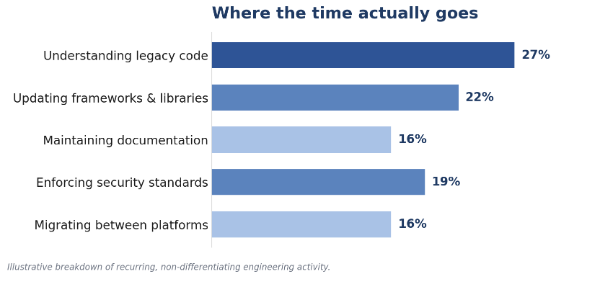
Recurring, non-differentiating work consumes a large share of engineering effort.
You can see the results without looking hard. Onboarding drags because too much of what matters lives in people’s heads instead of anywhere you can read it. Teams lean on the two or three engineers who happen to remember how a given system behaves. Security fixes arrive late, because just finding every affected application turns into its own project. And the modernization that was meant to relieve some of this keeps getting pushed to next quarter.
What transformation-driven AI actually means
The idea is to stop generating code snippets and start defining transformations that can run repeatedly. Instead of re-platforming a system by hand, one project after another, an organization writes the rules down once. Architecture standards, coding conventions, security requirements, the mapping from old technology to new, what counts as a successful result. Then AI applies those rules across the whole portfolio.
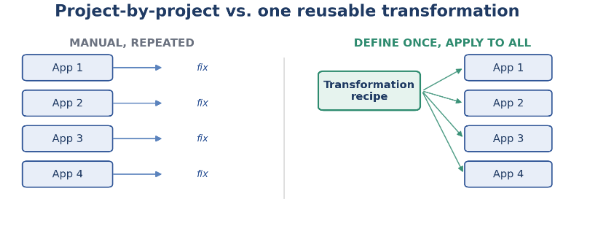
Instead of fixing each application separately, a single recipe is applied across all of them.
What you’ve written becomes a reusable recipe. The expertise that used to sit in one senior engineer’s head turns into something the rest of the organization can run against. That’s the part that changes the economics. Modernization stops being a string of separate projects and starts behaving more like infrastructure you can rely on.
A few examples make the pattern concrete.
Take an organization re-platforming its integrations off MuleSoft and onto .NET services. By hand, every integration gets its own analysis, its own implementation, its own round of testing. As a transformation, the team defines the technology mappings, the target architecture, the logging conventions, and the service boundaries one time, then runs that across every integration. The consistency alone is hard to get any other way, because hand-migration always drifts a little from one engineer to the next.
Documentation is another. Legacy systems are famous for documentation that’s either missing or years out of date, and nobody wants to spend a quarter writing it. AI transformations can read the source, pull out the business logic and the dependencies tangled up in it, and produce documentation as a side effect of the modernization work instead of a separate slog.
Security tends to drift between teams, so the same control ends up implemented five different ways across five applications. Write secure coding patterns, audit-trail requirements, and access controls as a transformation, and you can enforce them as you go rather than catching the gaps later in a review, after the code is already out there.
Infrastructure follows the same logic. Containerizing applications, generating Infrastructure as Code, standardizing pipelines. Define the standard once, apply it repeatedly, and you’ve cut both the effort and the risk of everything being slightly different.
The connection to DORA metrics
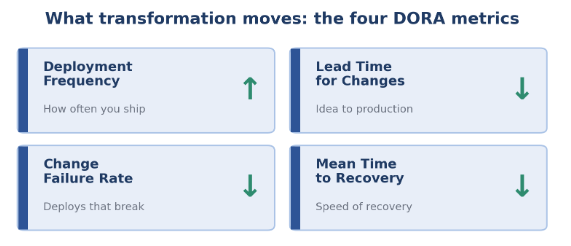
High-performing engineering teams tend to watch four things, and transformation-driven modernization moves all four in the right direction:
- Deployment frequency — how often you ship
- Lead time for changes — how long it takes an idea to reach production
- Change failure rate — how often a deploy breaks something
- Mean time to recovery — how fast you recover when it does
A security incident shows why most clearly. When a critical vulnerability surfaces in a dependency everyone uses, the response is simple to describe and tedious to carry out: find every affected application, apply the update, confirm nothing broke, deploy. Spread across dozens of repositories, that burns real engineering time, and the whole while the organization is sitting exposed. A reusable transformation folds that into one standardized workflow that runs at scale, so a multi-week scramble starts to look more like a routine job. Faster response, less exposure, better numbers across the board.